Showing posts with label Evaluation. Show all posts

Saturday, November 14, 2015

Pondering this week's events

Earth Image

Dear reader,

As you know, I’ve kept this blog going at an infrequent basis.  I had thought I would write on a bi-weekly basis on topics of interest, but allowing the system to develop on its own, am finding that I write when the inspiration strikes.  I’m embracing this position with the thought that I will only write when I think I have something useful/insightful/thoughtful.  I hope you find my thoughts today to fit at least one of those criteria.

For those of you who follow me on Twitter or are friends on Facebook, you are no doubt aware that I’ve been attending the 2015 American Evaluation Association conference.  Additionally, you have probably heard/seen/experienced the events in Paris.  Today was the last day of our conference and I’m now sitting in an airport lounge, waiting to travel back home.  I bring you these thoughts as I see a river of humanity flow by.  As an evaluator, it is my job to help individuals, organizations, and communities work to make the world a better place.  My efforts go to help these people articulate what they are trying to accomplish, how what they are doing should affect these changes, and to aid them in seeing if all this in fact actually happens.

In our recent conference, I was exposed to others, bent on similar missions - working with different people, engaging in different methods - but still all driving to help.  I watch the river of people flow by and I wonder, how many of them have similar thoughts, similar feelings, are personally and professionally dedicated to helping others.  Oh, and incidentally, I think you can be in just about any profession and have this orientation.

Today, I learned of the scale of horror that was perpetrated in Paris.  These individuals have lost sight of the notion of help, but choose to act to push their own position/opinion.  It isn’t a question of values, but of power and desire to exert it.  We see this not only this week in Paris, but in other parts of the world.  The dialogue around these things is only divisive, with polar viewpoints having the resources to broadcast through their actions and voice around the world.  There is no solution with these actions, only a flexing of power and perpetuation of status quo.

Today, I saw the public’s response to the horror that was perpetrated in Paris.  i saw people come together for moments of silence.  People changing their social media profiles.  People expressing their outrage and grief - perhaps as I am doing now.  But, beyond them, today I saw a different group of people.  A group of people I identify with - the helpers.  Mind you, the people at this most recent conference aren’t the only members of this group, but represent similar values and focus.

  • They are aware there are issues.
  • They are aware of who these issues affect.
  • They are aware of who can help address these issues.
  • They are concerned by the issues.
  • They are actively working with others to find the solutions.
  • They are actively working with others to affect these solutions.
  • They are actively working to improve upon those solutions.
  • They are actively working to ensure those solutions are sustained.

Many of these people, much as I, have expressed their grief at the most recent events in Paris as well as other events around the world.  Many of these events are not sudden, galvanizing events, but rather have been smoldering and simmering for generations.  As such, many of these things are not visible to much of the public.

Today, it is so easy to express grief or solidarity.  Change a photo on Facebook, like something, tweet or blog.  It is much more difficult to actually decide that you are going to be a helper.  We all affect change in our communities by simply existing within them.  A helper consciously chooses to do something because they think it might make a difference.  I’m suggesting to you, dear reader, that we can all be helpers.  In my case, as an evaluator, I do much of what I bulleted above.  I can do more and the events of this week (conference and what has occurred in the world) have reminded me of this.

I would ask that you consider whether you are a helper too.  Do you thoughts about your local and global communities end with a change in your Facebook status or a retweet, or are you doing something more?  Are you part of the polarizing rhetoric, driving any compromise or understanding away to focus only on an ideal or vision, or are you willing to step up and listen to all sides of the story, roll up your sleeves, and try to help?

As always, I welcome your thoughts and feedback.  Please leave comments with your thoughts.

Warm regards,

The Evaluation Evangelist

Thursday, June 11, 2015

Collaboratives and Capacity

As an evaluator, I get to see a lot of things. One of the many things I’ve learned is that quality programming is tied to the capacity of the organization to deliver that programming. TCC Group, the company that now employs me, has an instrument called the CCAT (http://www.tccccat.com) that helps organizations assess themselves along four core capacities - adaptive, leadership, management, and technical. If you are interested, you are more than welcome to have a look.

However, I’m not writing to just speak to individual organizational capacities, but issues of capacity within collaboratives. One of the “strengths” of a collaborative is that individual organizations can share resources - the old adage, “the rising tide floats all boats”. The statement sounds trite and to some degree it is. Just because there is some “extra” capacity in the community or collaborative, it doesn’t mean that it is recognized as such, much as less shared.

In the tenets of Collective Impact is the concept of a “Backbone Organization”. The job of this organization is to support the collaborative efforts of the organizations involved. Taken from a view of capacity, the Backbone Organization would be the one to identify the capacity needs and work within the collaborative (and outside as necessary), to find the resources to fill those needs. In my last role, I developed assessments of capacity for the organizations building collaboratives across many communities across the United States. I wish we would have used the tool here at TCC with some modifications - as it would have saved a great amount of time (but I digress).

While having a collective provides opportunity for finding untapped resources, there are more complications. In my own work, I’ve considered the following along with other issues:

  • What are the needed resources? Is it access to Human Resources support, staffing, equipment?
  • Where are the needed resources? Are they reasonably close that the organization needing them can use them? Are they at the level needed?
  • What efforts are necessary to ensure the resources are usable? Having access to internet bandwidth might be needed, but is there also a need for Information Technology support as well to ensure the bandwidth is usable?
  • What are the relationships of the organizations? Are they able to collaborate together beyond working on a similar goal?
  • Are issues of over-provision of services in the community and additional service deserts?

Some tools I’ve found to be of help are GIS Mapping and Network Analysis.

GIS mapping allows for looking at the big picture. It doesn’t hurt to know about where services are being delivered and where there is unnecessary overlap. Simply adjusting service areas can provide needed support to the community without any additional resources. It also allows the Backbone to map out capacity needs and resources, to look at feasibility of shared support or needs for specific organizations. That van isn’t all that useful if it is owned and used by another organization that is clear across town.

Network Analysis not only can help in mapping out and understanding relationships between organizations, but it can also be used to assess the sharing of resources. Over time, you can assess shifts in flow of resources as well as keep track of needed capacities.

This brings me around to my push for Evaluation as an Intervention. To be effective, the backbone of any collaborative or for that matter, the leadership of an organization really need to understand their capacities and how they can be brought to bear. The results of a capacity evaluation done in a repeated fashion allow these leaders to make the necessary changes (and identify where those changes can be found within their system).

As always, I’m open to your comments, suggestions, and questions. Please fell free to post in the comments section.


Best regards,

Charles Gasper

The Evaluation Evangelist

Tuesday, June 2, 2015

Evaluation as an Intervention

Today is the day.  Many of you know that I’ve been hinting at this for years, but today is the day that I make my own mark in the sand and tell you about my own “Theory of Evaluation”.  Please note, that much like other theories, mine is an evolution, not a revolution.  I don’t think I’m going to say anything here that is too controversial - unless you really subscribe to a certain viewpoint (which we will get to later), but I thought it was time.

Evaluation as an Intervention

A few blog posts back, I walked you through my growth as an evaluator - starting with a class in organizational development and working to try to understand collaboratives.  There, I introduced you to the idea of evaluation as an intervention - speaking about the engagement of evaluators in program design and use of evaluation data to inform evolution of programs.  Today, I want to make that case stronger and speak more about why I think it is important.

Evaluation is dead?  I don’t think it is, just evolving.

In April of 2014, Andrew Means posted on the page, Markets for Good a controversial post - “The Death of Evaluation” (www.marketsforgood.org/the-death-of-evaluation/).  In it, he takes to task “traditional evaluation” and makes some rather bold statements:
  • Traditional program evaluation is reflective, not predictive
  • Program evaluation actually undermines efforts to improve
  • Program evaluation was built on the idea that data is scarce and expensive to collect
The posting created a bit of a buzz in the nonprofit world as well as the evaluation world.  I heard a great deal of grumbling from fellow evaluators - “how dare he declare this!?!?!?!”  On the nonprofit side, I heard some quiet, “amen”s.  Neither surprised me.  Nor did it surprise me when I talked with a few funders and heard their thoughts - frankly they were as mixed as the nonprofits.  You see, there are still organizations out there, that unlike Mr. Meers, still want to prove (or at least in a more generous viewpoint, find out if) their program worked.  We’ll get to that in a bit, but more interesting is the trend of organizations that want to learn and move forward.  

To fail forward, you need to know why you failed.

In the world of Collective Impact, StriveTogether has promoted “failing forward”.  The only way to fail forward is to had information that the failure occurred in the first place as well as information as to why the failure occurred.  Frankly, in the areas of manufacturing and healthcare, folks are already way ahead of the nonprofit world - concepts such as ISO standards that ensure consistency of work and Six Sigma for failure assessment have been around for quite a while.  We also hear about performance improvement and quality improvement from these areas as well as others.  They have learned that a successful organization needs to be moving forward and improving to be successful.  Incidentally, they all do a great job of marketing around these concepts as well.

Tradition isn’t all it’s cracked up to be.

So, why does “traditional program evaluation” exist?  Why do evaluations that assess over a longer time with the program held constant (or perhaps affected by the environment) still get done?  I can think of a number of reasons, some perhaps good, some not, depending on your values.  Because frankly, it is the purchaser and user’s values that should be affecting what evaluation gets done.  Here are some of those reasons:
  • Intent to generalize the program to other environments - here people just want to know how the program works
  • Desire to market the program to others or to the current funder - the interest is in sales of the program, not changing it
  • Accountability focus - did the program do what it said it was going to do?
“Traditional evaluation” as Mr. Meers calls it, isn’t focused on learning - or at least incremental learning.  It is focused on the “big picture” - did the program do what we thought it was going to do?  As such, it does have its place.  The question is whether that “big picture” is valued or something else.

Programs evolve.  Why can’t evaluations evolve as well?

In my own thoughts on this, I came to an interesting observation.  Programs do not stay put for long.  They tend to evolve.  So, the “big picture”, long-term evaluation project becomes more and more difficult to conduct, because the maintaining a program as it was designed over years becomes more and more difficult to do as well.  While possible, it just isn’t likely that a program will stay exactly the same.  This is one of the reasons why my cousins who focus just on social science research view evaluation as something “dirty”.  They see it as having less control (the friend of research) of variables and as such, the work isn’t as pure.  It is also why researchers try to boost the rigor of an evaluation project - to try to clean up the dirt as much as they can.

But social programs and innovation specifically is very dirty.  There are changes all the time and Mr. Meers, because of his focus, doesn’t value the purity - he values a program that produces results and craves better results (sorry for putting words in your mouth Mr. Meers - I hope I’m right).  And so, I would argue it is time to seriously consider evaluation as an intervention.

Evaluation can’t be predictive, but it can support efforts to improve and by the way, it can use much of the data that is sitting around unrecognized and thus unused.  The trick is to embrace the dirt - such things as local context, environment, and change.  The cycle of collection and reporting also might shift a bit - depending not on the length of a grant or program goals, but more around expectations for change for shorter-term outcomes.  These “performance measures” and the hypotheses associated with them (yes, we are still taking science here) are the information that constitute the intervention.  They are often directly tied to service delivery or at least more closely associated with it.  And, they are meant to be shared with and used by decision makers as things go.  The real intervention occurs where the information is used and the stakeholders adjust the programming.  Another key hallmark of this work is that measures also do not stay constant over time.

Evaluate the system and program as it is, not as it “should be”.

Did I just surprise you?  I think I did!  I actually promoted the idea of dropping and/or changing measures over the duration of the evaluative work!  This isn’t how most evaluation work is done.  Michael Quinn Patton pokes a bit at this with Developmental Evaluation, but I’m saying that no measure is sacred - all can go.  Remember, the goal of this work isn’t to test a program’s impact, or generalize, or for that matter look for accountability - it is to improve the program.  As certain criteria are met and the program evolves, it is quite possible that some, if not all measures, will be replaced over the duration of the evaluation.  Measures that were meaningful at the beginning, become less meaningful.  This addresses Mr. Meers' concerns around evidence of performance and success - if (and it is a very big if) the stakeholders are still truly interested in improvement.  It isn’t the measures or measurer that determines whether a leader is content with their work - rather they only provide evidence for that leader to make an informed decision.  However, if the evaluation is designed to run on rails and get to a specific destination (and only that destination), pack your bags, for that is where it will wind up.

There are some rules to this.

And so, as we think of Evaluation as an Intervention, we have a few “rules” to consider (think of these as decision marks).  Evaluation as an Intervention:
  • Is intended for improvement of programs and systems
  • Is intended for learning
  • Isn’t intended for accountability assessment
  • Isn’t intended for those specifically interested in generalizability of their program
  • Isn’t intended for “big picture” assessments or marketing
  • Can be inexpensive (we will talk more about that in later blog posts)
Is this for everyone?  No, only if you need it.

As for Mr. Meers, I appreciate his view.  It is shared by many, but not by all and it is important to understand the needs.  It boils down to what information is important and to whom.  In the case of Evaluation as an Intervention, it is just that, recognizing and using evaluation to improve a program or system - not just document it.  And, as with all theories of evaluation, there are moments with one theory is more useful than another.  In my own practice, I engage multiple theories to support my work - I just felt that it was time to really define this one and give it a name.

I’ll be writing about this more in the near future as I work through this theory more.  As always, I’m open to your comments, suggestions and questions.  Please feel free to post comments.

Best regards,

Charles Gasper

The Evaluation Evangelist

Tuesday, April 14, 2015

My Return as a Blogger and My Life as an Evaluator

I was reading through my previous Blog posts over the past few years and I came across a post I made in November 17, 2010 – the title?...  Wait for it…  My Return.  There it had been over a year since my last post.  Well, once again, I’m writing about my return and once again, it has been over a year.

Changes

Today, I shared with many of you a change that occurred in my life.  I had been considering doing something like this for well over a year and finally decided it was time to switch things.  Earlier this month, I started working for the TCC Group.  TCC works with Foundations, Nonprofits, and Corporate Giving.  The institution has over 30 years of experience in the areas of strategy, grants management, capacity building and evaluation.

I was thinking it was a good idea to write about where I have been for the past year (really years) and why I haven’t written.  Then I realized – I have been working as an evaluator for over 20 years, have I ever really told you why I got into the business?

Have a seat, I’m going to share a bit here about how I got here.

Setting the Hook
In 1991 or so, I was an undergraduate student at Santa Clara University.  There, I was working with someone who would greatly influence my life, Dr. William McCormack.  One of the courses was on organizational development and we were required to work with an organization, writing a case study.  That experience drove me to think more about organizational effectiveness and impact – but it took a few more steps to put me on my path.

There was some additional evaluative work done, but in 1995 I found my love.  I was working on a project to assess the impact of a program on the quality of life of the individuals.  When the evaluation was completed and we submitted our findings, the state took our work and changed the program – improving the lives of the people served.  Thousands of people were impacted by my work!  I had found my calling.

Learning that Learning is Important
Along the way, I worked in quality management for a health system.  This experience molded my view on evaluation further, evolving it away from summative, value-focused work to learning and improvement.  Our work improved the experience and health outcomes for patients in hospitals and also resulted in organizational savings for the health system.  We weren’t conducting long-term studies, but instead focusing on short-term outcomes that predicted long-term success.  The mantra of the day for organizational change was, “what can we get done by next Tuesday?”

Movement to Large-Scale Impact and Collaboration
In 2007, I became a Director of Evaluation for a large health-focused foundation, the Missouri Foundation for Health (MFH).  It was time to think differently again – or perhaps better said, to broaden my thought.  Prior to coming to MFH, my focus was on program evaluation (even if the programs were larger).  Now it was time to see how multiple programs (yep, was still focused on programs) could interact with one another to affect larger scale impact.  During my stent at MFH, I also returned to graduate school and while my evaluative practice was informed by program theory, it truly shifted to being theory-based (I’ll talk about that in a later blog).  I started to think about systems in a broader sense, not only seeing how an individual program interacted with a larger system, but how systems change can affect improvement across broad swaths of issues.

Evaluation as an Intervention
About this time I started thinking about evaluation differently.  I recognized that programs and systems evolve over time and that evaluation can better support the effort if it doesn’t stand completely separate.  Provision of shorter-term information tied to program theory can better inform the evolution of programs and identify where the efforts are being effective.  There has been a shift in AEA in recent years, now recognizing that evaluators can be and some think should be involved in program design.  My epiphany in 2010 was my tied to my recognition that my role as an evaluator in a foundation should support such work.

Collaborative Impact
Most recently, I’ve focused on how collaboratives are built and the results of the collective effort.  I’ve been assessing how these efforts combine with and attempt to change simple and complex systems.  You can think of these as multiple programs working in concert.  In reality, the concert often sounds like a bunch of instruments tuning up versus following a score.  My work has focused on how to get the instruments to play together in the same hall, follow an agreed upon score and perhaps follow the baton of an agreed upon conductor.  (We will revisit this analogy in a later Blog post.)  There is a great deal to learn about collaboratives.  Certainly, this is something that has been done for years.  Folks have given it different brand names, but really it is just about learning how groups of people, organizations, civic leaders, and communities can come together to affect systems change.

Which Brings Us to Today
The process of moving to the TCC Group made me contemplate my practice as an evaluator.  In the interest in keeping this post relatively short, I only shared some of the revelations I made.  My journey reflects two key things, 1) my own personal growth in the field and 2) evolution in the field of social change.  To be clear, programs are still important.  Valuing the impact of those efforts is also very important.  However, sustainability of the programs and their supporting organizations, organizational and communal learning, and systems change have become more important as those attempting to affect larger scale change turn away from focusing on just their work to look at the environment around them.

And So It Goes
I hope you enjoyed reading about my evolution as an evaluator.  Much like the programs and systems we evaluate, my practice will continue to grow.  I would be very interested in learning your stories around how your engagement and understanding of evaluation has changed over time.
As always, I’m open to your comments, suggestions, questions and yes, your stories.  Please feel free to post comments.

Best regards,
Charles Gasper
The Evaluation Evangelist

Friday, March 21, 2014

March Madness and Evaluation

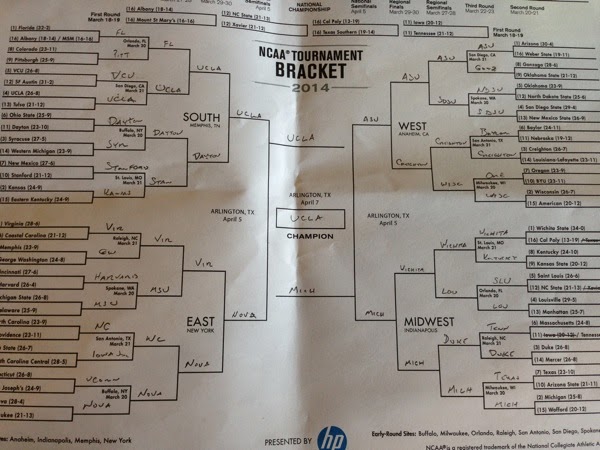
Let’s just get it out of the way - March in the United States is about basketball, college basketball to be exact.  The colleges have been playing since November, but it is March where the general public (people who normally don’t follow collegiate basketball) suddenly get interested and involved in filling out “brackets”.  If you haven’t seen one of these - here is mine...

IMG 2256 

So what is the relationship between the assignment of schools to the brackets and evaluation?  Well, that isn’t such a simple explanation.  What you see are my selections, but the story isn’t about what I wound up selecting, but rather the process I took in selecting them and the manner in which others make their own choices.  Let’s be honest, one of the major reasons we engage in evaluative work is to predict how something/someone will perform in the future.  In the case of selecting which schools are going to advance through the tournament, there is a good amount of evaluative data on the page for you to see.

The schools are ranked going into the tournament.

Their individual win/loss records are presented.

The location the games are being played are also presented.

Finally, who they are scheduled to play are part of the brackets.

While the analysts and bookies that spend significantly more time on this than me bring additional evaluative data to bear, we do have some interesting data which speaks to how we use evaluative data to make decisions.  Let’s break this down by the manner in which I looked at information and came to the startling conclusion that UCLA will win this year’s NCAA tournament.

One of things you will note, if you scour over my selections is that the higher ranked teams tend to be the ones I picked.  They also tended to have a higher win/loss ratio.  This basal information explains some of my decision process.  However, context of the game also plays a factor.  Much is made of the impact crowds have over games.  While a different sport, the Seattle Seahawks in professional American football and Texas A&M’s collegiate football team promote their in-stadium fans as the “twelfth man” - recognizing their “contribution” to the game.  So, the context of the game and a guestimate of the ratio of fans in the arena played a factor.

There is also missing data that went into the decision process…  Wait!  Did I say, missing data?

It isn’t missing, rather it is evaluative data that I used that wasn’t included on the paper - from other sources of “truth”.  To share a bit more about me, I’m an athlete and a coach.  I have participated in and coached multiple sports at a competitive level and recognize that in addition to the crowd’s influence in the outcome of the game, there are other factors that can affect an athlete’s performance.  This leads me to explain why I picked UCLA to win, much as less why other teams advance over others.  Namely, I’m familiar with the history of UCLA basketball and the fact that the coaches and the athletes can “call upon” that history to give them a bit of extra boost in their games.

This all leads me to explain more around why I’m using the tournament as a metaphor for a program and the information in the brackets as evaluative data.  There are a few lessons to learn here.

  1. I’m taking into account both the context of the game (program) and incorporating my sources of truth.  Good evaluation practices should incorporate what the stakeholders revere for information and data and the context of the the program implementation.  Better use of evaluation data for decision making should also take these factors into account.
  2. I’m clearly using flawed data for my decision making.  Just looking at my final game - UCLA versus Michigan.  I know UCLA’s history, I don’t know Michigan’s.  It may be that Michigan has an incredible history as well, and to be honest, there is a nagging part of my brain that is saying that there is something there as well, something big.  However, I made decision to ignore that part of my brain when making my selection.
  3. Speaking of ignoring information, let’s look at my decision to pick Stanford over Kansas.  And this highlights decisions that can be disguised as informed by evaluation, but in fact are made “from the heart”.  Living in Missouri, there is a bias against Kansas - don’t ask me where it comes from, but there has been at minimum a rivalry for years between the states’ schools.  Add that I attended a Pac-12 school for a period of time and my “allegiances” and thus decision making becomes clear. The lesson here is that while we would like to say that our programmatic decisions are driven by evaluative data, our own biases do creep in.  As leaders who use evaluative data to make decisions, we need to recognize our biases and be honest with ourselves and our teams.

It is these lessons that will serve us all well in both working as evaluators, but also as consumers of evaluative information and decision makers.  Paying attention to the context of the program, the agreed upon sources of truth, the fact that some information may not be found in the official structures of the evaluation, helps improve our understanding of the program and inform decision making going forward. And even if we have all the data we need, the complexity of the program may result in a different outcome than we expect - as history will certainly prove with my bracket results.

As always, I’m open to your comments, suggestions, and questions.  Please feel free to post comments.

Best regards,

Charles Gasper

The Evaluation Evangelist

Monday, August 20, 2012

Complexity - Excuse or Misunderstanding?

Is complexity an excuse or evidence of lack of understanding? Friends, have you ever had the situation where you have asked someone to explain why something happened, or perhaps why they are feeling a certain way and you have gotten the response – “its just too complex to explain”? I wish I could see the wry looks on at least some of your faces or perhaps the silent nods. One of the major responsibilities of an evaluator is to attempt to understand the program or organization they are evaluating. As most of you know, especially if you have read my past Blog posts, I adopt a theory-based framework for my evaluative work. That means that I’m constantly asking not only about the connections between activities and outcomes, but also why the team believes the relationships exist. Often times, I get a response that is very much like the quote above – “our work is just to complex to consider, much as less model!” Yet, the core concept of theory-based evaluation is the idea that we can get to the underlying connections and reasons.

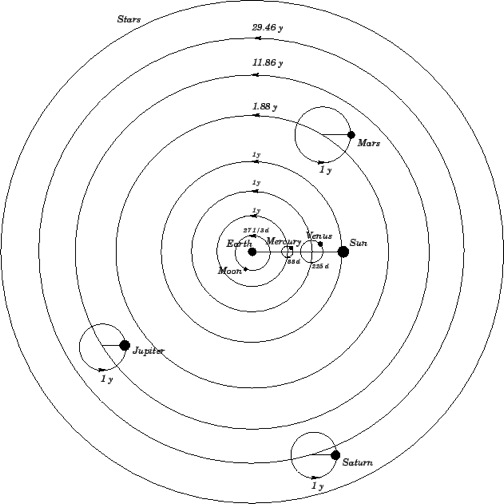
Much like the Kuebler-Ross Stages of Grief (http://en.wikipedia.org/wiki/Kübler-Ross_model), many of the teams I’ve worked with have gone through stages that start with “it is too complex” to “yes, that is what we do and why we do it”. Once we get people to actually agree to engage with us, their models reflect the complexity seen in models such as this.

B69B44AA-0E89-4209-AA89-2C2EC37840B3.jpg


If you remember your high school physics class and had paid attention during any astronomy class, you will remember that the model above found at (http://farside.ph.utexas.edu/teaching/301/lectures/node151.html) is the Ptolemaic model. To make the complexity of the model work with Earth in the center, the planets need to orbit around a central point as that central point orbits around the Earth in a direction opposite that which earth rotates. The machine necessary to model this looks like something like this, found here (http://remame.de/wp-content/uploads/2010/03/astrolabe_2.jpg):

7E0A52DC-58F5-43B7-AD50-90ECE6FB6AC1.jpg

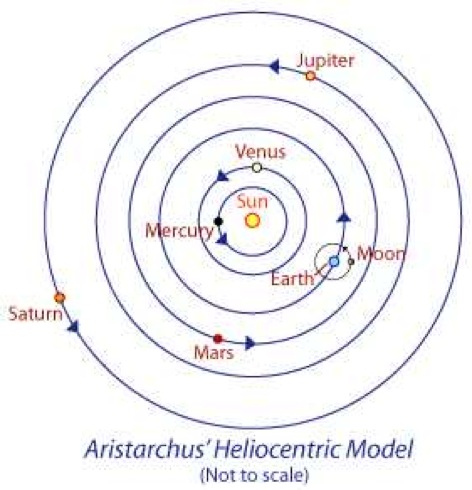
Note the complexity of the gearing and process to model the complexity. However, there is another step – moving to a simpler model and that requires the team to take a step back and not have a geocentric viewpoint of their own program or organization, but rather to try to look at everything a little bit different. In the case of astronomy, opening to the notion that the center of gravity for our local solar system resulted in a simpler model – something less complex found here (http://biology.clc.uc.edu/fankhauser/classes/Bio_101/heliocentric_model.jpg)

902893B2-7733-48AF-AA4A-82B336D2D35D.jpg


and results in simpler mechanics as can be found here (http://www.unm.edu/~physics/demo/html_demo_pages/8b1010.jpg)

5B9D2384-CFB3-41D9-BF8A-6A200D0F4177.jpg

The simpler model allows for a more accurate representation of what is actually happening and then allows for corrections such as the fact that the planets do not orbit the sun in a perfect circle. In organizations and programs, similar moments of clarity allow the team to test deeper assumptions and improve their associated projects.

Now, let’s be honest organizations and their programs, much like true orbital mechanics aren’t simple – there are layers of complexity. However, there is true complexity and there is complexity driven by poor assumptions or inability to stop and look at things objectively. The role of the evaluator is to help break down these viewpoints and help the team see through the complexity they have invented due to their preconceived notions to help them see the true underlying mechanics of their work and its outcomes. The process isn’t easy and in some cases, I’ve found that the work I do is more like a therapist than like a researcher. There can be displays of frustration and anger as the team works its way through understanding their organization or program. And much like some therapy sessions, the team can pretend that there is agreement among them when there isn’t – unifying against the evaluator to avoid the pain of the experience and/or the possible pain of discovering that their world view isn’t as clear as they would like. I will write more about process another day, but suffice to say, opening people to other views can be rather difficult work.

So back to the original question, is complexity an excuse or evidence of lack of understanding? I’ve often found it can be both and with that in mind, the wise evaluator, interested in understanding the theories of an organization or program, will continue to try to get their team to “simply” their model of their theory. It is in that simplification that real and difficult discussion occurs that provide insights as to what the organization or program is trying to accomplish and how.

Also, please note that at no point did I say that complexity isn't a part of everything we do - it most certainly is. However, experience would indicate that when we think about what we do and how we do it, our mental models are significantly more complex than reality. Further, our perceptions of what we do and why is often colored by how important we want to feel and how much we desire others to understand how difficult it is to be us. To those of you who fight to help teams tease out the try complexity from the self-generated complexity… To those of you who struggle to bring clarity to a complex world… Thank you!

As always, I'm open to your comments, suggestions, and questions. Please feel free to post comments.

Best regards,

Charles Gasper

The Evaluation Evangelist
Thursday, January 5, 2012

If Your Friends Were Jumping off a Bridge, Would You Do It Too?

Ok, show of hands – how many of you had parents that asked the title of blog or a similar question when you were a teenager? I’m looking forward to a number of years from now when I utter those words out loud. Truth be told, I have had several opportunities in the past years to say something similar when working with organizations around evaluation.

It doesn’t take much to recognize that I’m a strong proponent of evaluation. Would a guy who didn’t think evaluation was important call himself The Evaluation Evangelist?... However, I am also a strong proponent of use of the information gleaned from an evaluation AND very much against wasting resources on creating information that will not be used.

I’m going to ask you to raise your hands again here… How many of you have been asked to design an evaluation and when you ask your client those fateful words – “what would you like to learn?”, you get a response of a blank look, confusion, or something to the effect of, “we don’t know, we were hoping you could tell us”? Trying to get more information, you might follow up with a question like, “why do you want an evaluation done?” and get the response of “the funder wants one”, “we are supposed to do an evaluation”, or the like. More often than not, I find myself on the receiving end of one of these responses.

As consultants, do you find yourself trying to design an evaluation for a client that doesn’t know what they want or why they are hiring you to do the evaluation? As program or organizational leaders, are you finding yourself hiring evaluators without knowing what you plan to get out of the evaluation? My guess is that at least some of you are nodding your heads or at least remembering a time when you might have found these to be true.

So, why is evaluation so popular these days? As people interested in the promotion of evaluation, why should we care as to why evaluation is popular and just enjoy the fact that interest is increasing? As an evangelist, shouldn’t I just be content that people are now asking for evaluation and thus I’m employed to help them understand what evaluation can do for them? To this, I must answer an emphatic NO!

Evaluations done just because a funder requires it or because the leadership has heard or read somewhere that it is a good thing to do (or worse, because it just is something one must do) will end up not being used. At best, the contracted or internally hired evaluator might be able to work with the organization to identify evaluation questions – but in the end, the organization needs to be the one driving the questions.

Metaphorically – think of the joke about the drunk that has lost a quarter and is looking under the streetlight. Along comes a guy who asks the drunk what he is looking for and the drunk tells him about the quarter. The guy asks the drunk where he lost the quarter and the drunk points off in a direction and says, “over there”. When then asked why he is looking under the streetlight, the drunk says, “the light is better over here.” I liken this experience to the organization that is asking for evaluation without guidance. In this case, the drunk (the organization) wants help to find something and the guy (the evaluator) winds up having to ask all sorts of questions that may unpack an issue to address.

But it can be and often is worse… For these organizations often don’t have evaluation questions formulated, it is as if the drunk is searching for something, but doesn’t know what it is. He may actually have never lost the quarter in the first place. As such, the helpful evaluator might find a different quarter, a dime, a stick of gum, and a rusty bolt on that sidewalk as well. All these things might be useful in some ways to the client, but since he doesn’t know what he is missing (if anything), he may not value the findings. As such, the evaluation findings are not used.

Now, some may argue that there are situations where having evaluation questions on the front end isn’t a good thing. Perhaps those situations exist, but even then, I would hope that there is some reason for engagement in evaluation other than just because it is done or others are doing it.

So dear reader, I leave you with a thought for the next time you consider an evaluation (either requesting one or supporting one). Think to yourself, why are you on the bridge and why are you considering taking the leap. Is it because it is in support of thought out evaluation questions or because everyone else is doing it?

As always, I’m open to your comments, suggestions, and questions. Please feel free to post comments.

Best regards,

Charles Gasper

The Evaluation Evangelist
Wednesday, July 13, 2011

Educating This Generation’s Evaluators

Some of you may know that I am on an incredible learning journey called “Graduate School”. I am nearly a year into this experience and can honestly say that my own thoughts around theory and practice have been influenced this past year. Clearly, the work of Claremont Graduate University as well as Western Michigan and a few other schools are brining a focus and commitment to professional evaluation otherwise not found. They are creating masters and doctoral “prepared” professionals into the world to engage nearly anyone they can in evaluation. If you want to get a sense of how important I think that is, just skim through the titles of my previous postings over the years. I think there is room for more of these institutions around the globe as my own experience of being the ultimate commuter student to pursue my own PhD has taught me. You see, there wasn’t a school nearby with a strong evaluation focused program in which I could expand my own knowledge and expertise. There wasn’t the community of thinkers locally available. So, first with Claremont’s Certificate Program and later my application and acceptance to the Graduate Program – I found my community. However, I think the stars aligned and I was lucky. Claremont and just started the Certificate Program (I was in the first cohort) and if it wasn’t for the vision of the leadership of Claremont’s Psychology Department with Stewart Donaldson at the helm, I would be stuck, wishing.

As you can probably guess, I have an idea… Well, a few anyway.
1) Online programs have a bad reputation in the academic world. There is a viewpoint that they are not as rigorous as residence programs. This viewpoint needs to change. Online participation in residence programs is now possible – my experience is case in point. In fact, there are times that I believe I get a superior experience to the resident in the classroom, having access to a teaching assistant with whom I can discuss thoughts and ideas that occur to me during the class that I wouldn’t want to disrupt the class in their vocalization. Granted, my experience is a bit different than other online experiences – perhaps in the area of requirements. But, with a bit of effort, the technology is currently present to maintain those requirements – even when the student is thousands of miles away from the campus. I suggest that the schools that educate and train professional evaluators examine this idea more closely and experiment.

2) Workshops at conferences, institutes, and the like are good entrées to topics, techniques, and theories of evaluation – but that about covers it. The onus is on the “student” to seek out additional venues of learning, usually books or websites. AEA has done some fantastic things to offer more information to members in the form of AEA365, its Linkedin group, EVALTALK, and others. EVALTALK was my link with the evaluation community, a place to ask questions from time to time and Linkedin as assumed some of that role as well. AEA365 provides great tips and links to useful ideas – but there is still something missing, an organized, progressive training opportunity for evaluation professionals.

On a daily basis, I work with both amateur and professional evaluators. Frankly that differentiation is unfair. I work with folks along a spectrum of evaluation knowledge and skill. I engage academics that have poor evaluation knowledge and skill as well as academics that are highly knowledgeable in this arena. [At some point, I will write more about the differentiation between content experts and evaluation experts – something a good number of nonprofits and funders misunderstand.] I also engage individuals with bachelors and masters degrees in fields not traditionally associated with evaluation or research that are highly knowledgeable and yes there are those with little knowledge in this category as well. Sending all of these people to a workshop to learn aspects of evaluation is not going to go far in improving their abilities. They need more support than that.

My own work in this area is leading me to a coaching model for engaging and training those lower on the evaluation knowledge continuum. In such a model, technical assistance in the more traditional forms of workshops and one-on-one training occurs – but that the “instructor” or “coach” continues to have contact with the “students”, providing continual education as needed for the “student”. Like a player of a coached team, the “student” receives the training and then is allowed to “play” (conduct appropriate evaluation work at their level) with additional mentoring and advice from the coach. Occasionally, the “student” returns for training (again, envision a team practice) for additional skills/knowledge development. We are testing this in a few projects I’m associated with and if you happen to attend this year’s AEA conference in Anaheim (http://www.eval.org/eval2011/default.asp), you are most welcome to catch a presentation sharing our experiences with this in one organization and where our theory of capacity building has evolved.

However… This still leaves a large gap in the education of evaluators – specifically the group I would call semi-professionals. These are the people on the middle of the continuum that have perhaps a master’s degree or even a strong research focused bachelor’s degree. They often have been practicing evaluation for a shorter period of time and if they are lucky, work in an organization with a more experienced and/or better trained evaluator. But often, they are not – and they are looking for additional educational opportunities. They may sign up and attend workshops on topics, but as mentioned earlier, these are just teasers relative to the depth of focus found in a graduate level course on the topic. Oh – and the reason I can speak about this is this was me many years ago and as I mentioned, I eventually got lucky. But until I got lucky and was able to find a program that was a good fit and allowed me to stay in my profession – I did what most of these semi-professional evaluators do. I attended workshops, conferences, and read books, journal articles, and posed my questions on EVALTALK. And honestly, it wasn’t enough. Yet, with exception to a few opportunities, there really is not much out there for the advancement of people falling into this category. Some are early enough in their careers that they can make the move to a direct residence program. In my case, the residence program accommodated me. But, there need to be more opportunities like mine – otherwise, we are leaving the semi-professional evaluators to their own devices with little support.

Do you have ideas to how to build evaluation capacity and knowledge? Please share!


As always, I’m open to your comments, suggestions, and questions. Please feel free to post comments.

Best regards,

Charles Gasper

The Evaluation Evangelist

Wednesday, February 23, 2011

Language and Evaluation

A great many people have spent a great deal of time thinking about what differentiates evaluation from research. I won’t press too far in this, other than to share that if you Google for the statement “difference between evaluation and research” as of the posting of this Blog, you would get over 5000 hits. Now, I’m sure there is much repetition in the form of quoting others and the like, but still – 5000 pages in which that statement occurs. Well, I’m going to talk about one aspect that affects my life almost on a daily basis – issues of language.

The current state of the art of evaluation suggests that a good evaluator is one that engages his stakeholders. What does that really boil down to? You have to talk to the stakeholders. Now, stakeholder is actually a very large word – and no, I don’t mean the number of letters or the fact that it might be a higher order vocabulary word for the SAT, ACT, or GRE. Rather, the concept of a stakeholder can spread across many different groups of individuals depending upon what sort of approach and philosophy you have about programming and evaluation. I’m not going to go into the various possible combinations, but suffice to say that you can be dealing with people who fund the program, implement the program, participate in the program, are not participating in the program, are in the community where the program is implemented, are not in the community where the program is implemented, and on and on and on. The combinations aren’t so much important to this Blog post as is what consists their background, understand, and vocabulary.

A few years ago, I had a discussion amongst individuals who all work for the same organization. These individuals all held the same position within the organization. This organization used and currently still does use the word – Objective. When asked what the word meant, the broadest definition could be – what the program is trying to achieve. However, that is where things broke down. For some, Objective meant a Programmatic Outcome. For others, Objective equated to a Programmatic Output. Still for others, an Objective was an Organizational Outcome. And for yet another group, it was a change in Organizational Infrastructure. All were focused on “Measureable Objectives”, but no one really agreed on what an Objective was. After a year’s worth of discussion and negotiation, we came the agreement that and Objective would be a Programmatic Outcome or Organizational Outcome. At least we got it to an “Outcome”.

When was the last time you had to have a discussion about the language amongst researchers? Ok, those of you who do language research, put your hands down! You get my point, I hope…

But the point was driven home to me again today. In a meeting with folks that I met with, along with another three evaluators, we discussed an evaluation project we are designing. During this meeting, I uttered another word, that I thought we all understood – “Comparison Group”. And was shocked to discover that their impression of what the term meant and my own impression and that of the other evaluators diverged. When they heard “Comparison Group”, they translated that to “Control Group”. They had a decent definition of a Control Group and we all know that engaging a Control Group for a study can require significantly more resources than engaging a Comparison Group, especially when the Comparison Group is not individually matched.

[Pausing for a moment here, because my own language may differ from your own… Control groups are usually associated with random control trials (RCT) and the costs of engaging in a RCT in community based programming and evaluation are very high. Control groups are a subset of comparison groups, which are just a group with whom you compare the outcomes of the group that experienced your program.]

The meeting around this study was rapidly devolving and the design was in jeopardy until I figured out that this was a language issue and not a design problem. The team had agreed to the design. They were under the impression that I was forcing a more rigorous study that would be costly across several domains. I was under the impression that they were stepping back away from the design and wanting something significantly less rigorous. Conflict was brewing. Fortunately, the issue of language was identified before things spun out of control.

I’ve presented the idea before and I’ll present it again. We need better-informed consumers of evaluation. Too often, I find myself and other evaluators changing language and/or dropping evaluation vocabulary out of discussions to attempt to avoid misunderstandings. I’m starting to wonder whether we are doing our clients and ourselves a disservice for this. In our own desire to make things easier for everyone in the short-term, we might be causing issues for the next evaluator. Worse, like the discussion around the term Objective, our looseness of language might cause more confusion. I’m considering short study for myself – to keep the evaluation language in and attempt to be more precise in my definitions with my clients – to see if I can reduce confusion. Anyone else want to give this a try? I would also like to hear your thoughts on the idea.

As always, I’m open to your comments, suggestions, and questions. Please feel free to post comments.

Best regards,

Charles Gasper

The Evaluation Evangelist
Friday, October 23, 2009

Evaluation, Standards of the Profession

Well, it certainly has been some time since I posted here. As I mentioned earlier, my goal is to post twice a month. Clearly, I’m not meeting my milestones. After a review of my process, I have modified my plan and expect you will see more posts in the future, meeting that goal.

Today’s topic focuses on the professional side of evaluation. Up till now, I’ve been presenting the rationale for evaluation and its importance in organizational and program development and maintenance. In the past few months, I ran into an issue that has made me think more about the profession of evaluation and standards. Funders and nonprofits are often faced with the decision of hiring outside their organization for evaluation support. How does one pick an evaluator and how do you know if an evaluator is good?

These are great questions and something that I am still struggling with. I would say that the contractors I work with are fantastic. Yet, the only commonality that they share is that they are university based. Otherwise, they have different backgrounds, different skill sets, and different views on how evaluation should be conducted. Last year, I brought them together to share their work with each other and it is something that our Foundation will continue to do. The differences amongst these contractors were rather striking with some noted below:

· Quantitative versus qualitative methods

· Different focus on aspects of program (e.g. sustainability, quality improvement)

· Different background training and focus (e.g. public health, public policy, education)

However, there was a common factor that all shared. They had training in and followed “research” methodologies tied to their backgrounds. While there are some language differences, individuals trained in public health, psychology, social work, and sociology all have taken basic levels of social science research methodologies. As all of the evaluators are university based, they are required to conform to human subjects rules and pass their designs through an Internal Review Board (IRB). That is a very large commonality and it constrains the work that they do. Further, it develops a form of minimum standard for these evaluators.

But evaluators aren’t just based at universities. There are many independent contractors that provide evaluation services. These contractors can come from similar backgrounds to the ones I listed above, but can also have other backgrounds that vary in education (type and level), philosophy, and technique. Those without social science backgrounds may have different standards of “research” that they have learned. Finally, most of these contractors are not subject to some form of IRB. As a result, there is the possibility of greater variation. The purpose of these thoughts are not to speak to the idea of variation, for I believe that it can be both good and bad, depending on the situation, needs of the stakeholders, etc. Rather, I want to look at this issue from a concept of minimum standards.

So, to identify a minimum standard, we need to all agree on what is evaluation. Again, we can argue this as different cultures have different views on this. Instead, let us assume that you and I have are own definitions with the common idea that at the end of the day, we will have the information we want to have. So, I would argue that the first standard of evaluation is really driven by the needs and wants of the primary and associated stakeholders. In my framework, that means the development of a theory-based logic model of some type that links what the program or project or whatnot is doing with outputs and outcomes that we are trying to affect which will in turn inform my team as to what they might want to know. Additionally, there are other strategic needs that can inform the evaluation design and minimum standard for review (e.g. organizational strategic focus, environmental assessment needs)

Once this first standard of informational need is identified, we now have the minimum standard of what we want to know. The next step is to identify the how and what will be done or some sort of methodological standard. This is where things get a big complicated, but can be teased out/cleaned up.

To begin, there is the basic rule of human subject rules that borrows a bit from the Hippocratic oath – “do no harm”. If some harm must come to the participants, then the benefits of what are learned must outweigh the cost and reasonable efforts must be taken to ensure that the damage is addressed. Incidentally, I would propose that the organizations engaged should also be viewed in this manner. The evaluation should not damage the organization and reasonable efforts should be taken to ensure that any damage is addressed. Unfortunately, I have had an experience in which tenets of this rule were not applied at the organizational level (the aspect of informed consent to the evaluation) and some damage was done and worse, ignored. So, the second standard of professional evaluation should be not to harm the individuals, programs, or organizations engaged in the process.

I should clarify, that the manner in which the individuals and organizations go about applying their evaluation derived information can and should be covered under this as well. It is the evaluator’s responsibility to ensure that the organization that receives the information is given every opportunity to correctly interpret the information. However, beyond ensuring that the information is interpreted appropriately, I don’t bind the evaluator.

The third standard would be acceptance and willingness of the evaluator to be bound by the guiding principles of the American Evaluation Association. - http://www.eval.org/Publications/GuidingPrinciples.asp. In essence, the guiding principles cover the first two standards listed above, but I feel them so important as to separate them out. However, the guiding principles also address in general the concepts of systematic inquiry, including education of the stakeholders on methodology and limitations, evaluator competence, integrity, respect for people, and responsibilities for general and public welfare. While membership in the American Evaluation Association does not indicate that the evaluator considers themselves “bound” by these principles, they have been made aware of them in various forms including –the Association’s website and the American Journal of Evaluation.

Earlier this decade, members of the American Evaluation Association discussed the development of constraints to better define an evaluator. Ideas floated included an exam and some sort of certification. Even this year, membership still struggles with identification and development of a tighter, more distinguishing definition of an evaluator. Again, one can find calls for an Association related certification, but given the breadth of what defines evaluation, a single test or even series has been rejected by other membership. Many universities provide training in evaluation and/or evaluation linked skills - http://www.eval.org/Training/university_programs.asp as well as other organizations that provide professional training and in some cases certification. This patchwork of diplomas, certifications, and training provide something in the area of constraint. One will have a better sense of the skills and training of a graduate of the Claremont Graduate University or Western Michigan’s programs, but it requires the person hiring said evaluator to be familiar with the programs. That means that I, as Director of Evaluation for my Foundation, must be familiar with these and other programs. Fortunately, I’ve been a member of the Association for several years and have had a goodly amount of contact with faculty and graduates of these programs. I have not had much contact with faculty and graduates of American University or California State University, Los Angeles. I have known people to attend the Evaluator’s Institute - http://www.tei.gwu.edu/, but am unfamiliar with their work and know little other than the brochures that lap against my inbox on a yearly bases about that training. So, what is a Director of Evaluation for a foundation to do, or for that matter, a Director of a nonprofit, when reviewing a proposal from a potential contractor?

First, know what it is that you want out of an evaluation. What is the information you want to know about the program(s)/project(s) and document it. It has been my experience that when presented with a vacuum, evaluators will build what they can into the evaluation’s structure. While some serendipitous information that could be of value can be discovered, it is far better to give the contractors a sense of what you and organization wish to learn. This information should be incorporated into the request for proposals (RFP). Second, the RFP should also include a requirement that the contractor agree to and adhere to the American Evaluation Association’s Guiding Principles. Finally, request to see previous work from the contractor, to get a general sense of philosophy and style of evaluation.

In review of these documents, think about your organization and the stakeholders of the evaluation. Do the stakeholders value one methodology for garnering information over another? Will the evaluation provide you with what you want to know? Really, the question is - is the contractor and their evaluation design a good fit for you? That fit, agreement in philosophy, focus, intent, and concern is critical. Without that fit, the most rigorous evaluation design that develops all sorts of potentially useful information will lay fallow for a lack of investment of the stakeholders.

Incidentally, I struggle with selection of contractors for our evaluations, much as others do. I value the diversity that makes up the Association and the profession of evaluation, so I oppose stricter constraints on the use of the title of evaluator. However, the above is the “best methodology” I’ve developed to select contractors.

As always, I'm open to your comments, suggestions, and questions. Please feel free to post comments.

Best regards,

Charles Gasper

The Evaluation Evangelist